
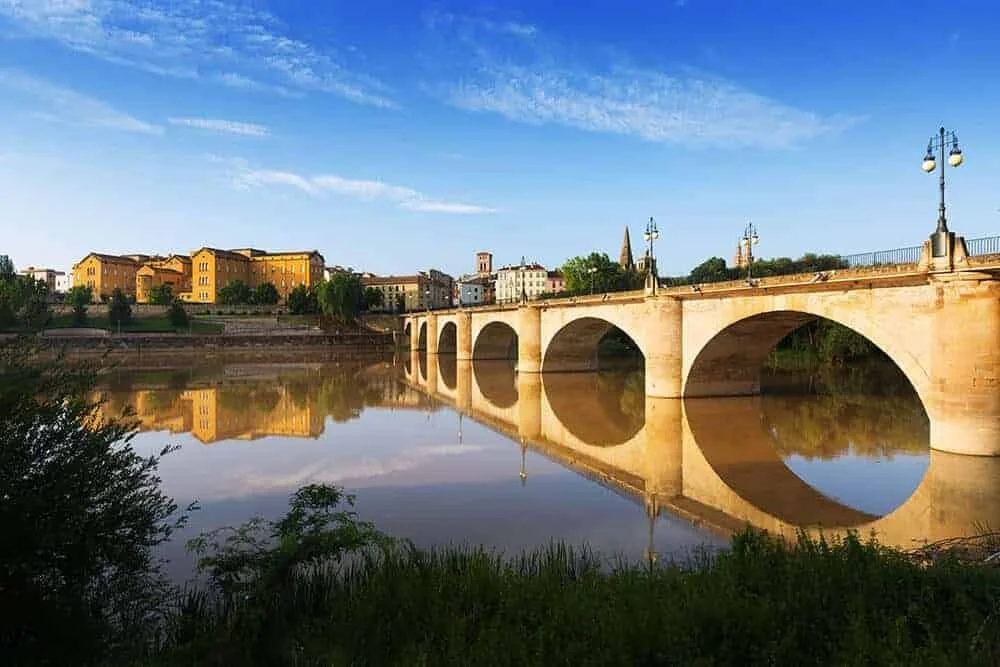
Logrono, capital of the Rioja district, on the Ebro River
la rioja
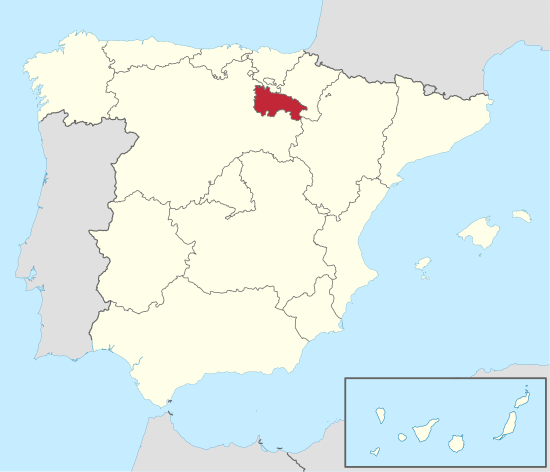
La Rioja (from Rio Oja) is an autonomous community and province in north central Spain, along the Ebro river which flows east into the Mediterranean a bit south of Barcelona. Its capital is Logroño. It covers part of the Ebro valley towards its north and the Iberian Range in the south.
The area has been settled since at least the Neolithic, and the Romans encountered several indigenous groups including the Berones and the Vascones as they pushed west from the Mediterranean coast. After some 700 years as part of Roman Hispania Tarraconensis, the region was conquered by the Visigoths, and was then invaded by the Muslim Arabs on their push up into today’s France, where they were finally stopped by Charlemagne’s father Charles “The Hammer” Martel at the Battle of Tours in 732. Several centuries later, the region became part of the Kingdom of Pamplona, which itself was absorbed into the Kingdom of Castile. From the eighteenth century the Rioja region remained divided between the provinces of Burgos and Soria, until in 1833 the province of Logroño was created, changing the name of the province to La Rioja in 1980 as a prelude to its constitution under a single provincial autonomous community in 1982.
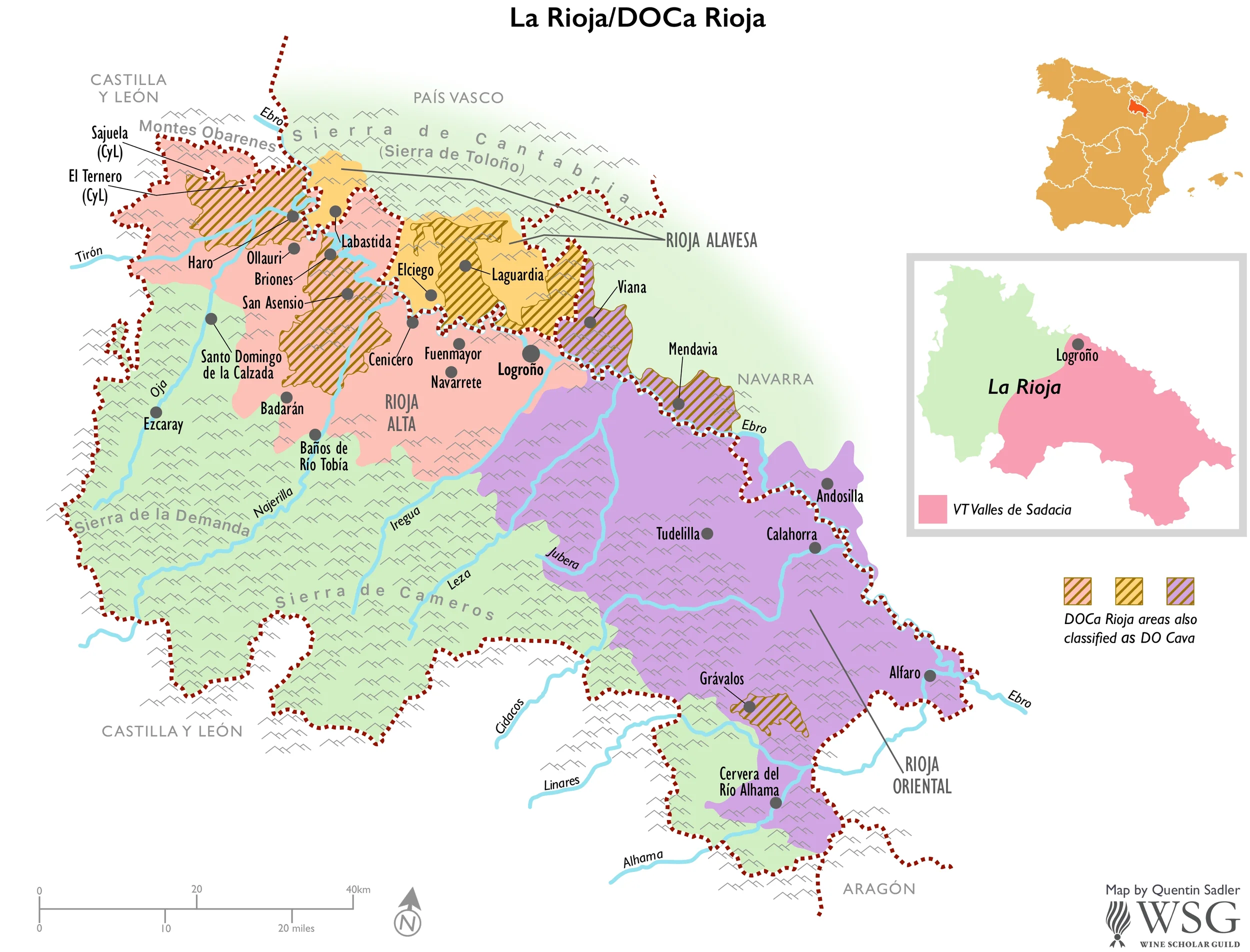
The region includes the Ebro Valley and the flanks of the Iberian System to the south, with its seven valleys (from west to east, the Rio Oja, Rio Najerilla, Rio Iregua, Rio Leza, Rio Jubera, Rio Cidacos and Rio Linares, each flowing generally northeast into the Ebro) that make up the viticultural area. Across the river to the north lies the Rioja Alevesa (adjacent to the province of Aleva), and the knife-edged Sierra de Cantabria. The geology is complex but is dominated by limestone- and clay-derived soils. The entirety of Rioja covers some 164,000 acres under vine, managed by (as of 2025) 552 wineries.
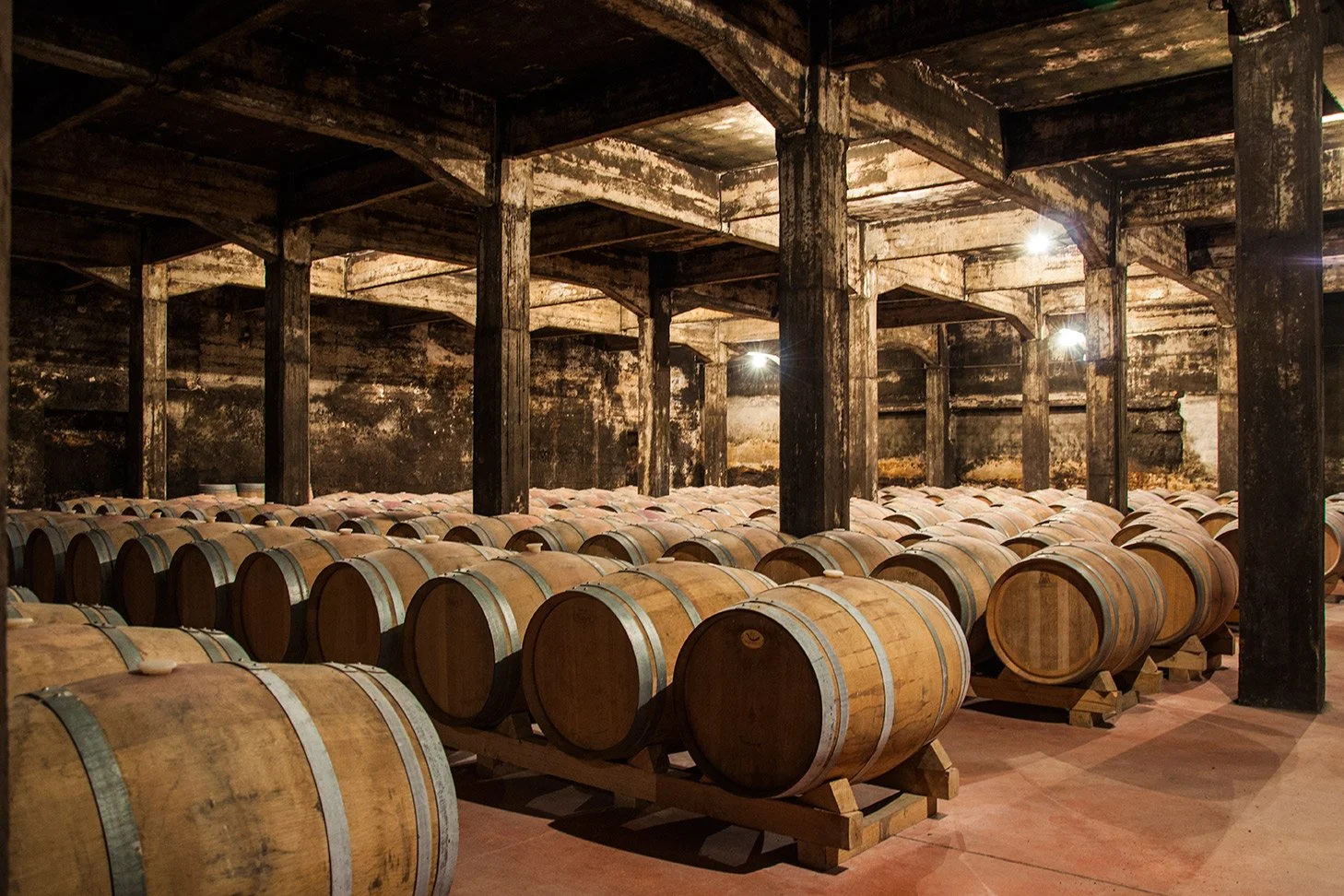
Barrel cellars at Bodegas Muga
The Rioja Oriental (formerly Rioja Baja) has richer soils and produces heftier wines from its 62,222 acres of vine, while the Rioja Alta (68,841 acres) and the Rioja Alevesa (32,550 acres) have thinner soils and produce elegant, aromatic wines.
Today, Rioja is one of the most dynamic wine regions in the world, an epicenter of enotourism, art and architecture like none other.

Frank Gehry’s masterpicee at Marques de Riscal
Rioja: Wines
Viticulture in the area was introduced by the Celtiberians in the Bronze Age, expanded by the Phoenicians and then greatly expanded by the Romans after their defeat of the Phoenicians during the Punic Wars (264-146 BCE) and subsequent absorption of Carthage’s Iberian territories. Viticulture was continued under the Visigoths, and after a pause during the Arab occupation, resumed under monastic control as the Catholic Kingdoms pushed south, eventually to Granada. Legal recognition of Rioja as a designated wine region dates to a decree of the King of Navarra & Aragon in 1102.
Rioja Geographic Classification
Rioja wines are classified by their regional specificity and by their degree of aging, both in barrel and bottle.
Wines simply labelled Rioja may be produced from vineyards anywhere within the DO.
Vinos de Zona are wines geographically indicated by their zone within Rioja- Rioja Alavesa, Rioja Alta and Rioja Oriental.
Vinos de Municipio are wines that list the village (municipio) of origin on the label, and must be produced within that municipio.
Vinedos Singluares are wines produced from a single, recognized vineyard, and again not only must the grapes be from that vineyard, but the wine must be produced within that vineyard. This demarcation level, created in 2017, is meant to showcase individual vineyard sites of special merit. Among many other requirements, the winery must have proof of ownership going back at least ten years, the vines must be at least 35 years old, all fruit must be hand-harvested in a single pass, the fruit must have a documented chain of custody from vine to bottle that is separate from all other wines, and wines must pass a second level of blind tasting to ensure quality. As of 2024, there are 162 recognized Vinedos Singulares in Rioja, comprising some 408 acres of vine.
DO Regulations
Established in 1925, the Rioja DO was elevated to DOCa (Calificada) in 1991. It remains one of only 2 regions having gained DOCa status- the other is Priorat. The DO allows both red and white wines, with an overlapping zone designated as part of the now non-geographic Cava DO.
Permitted Grape Varieties
14 grape varieties are permitted, including Viura, Garnacha Blanca, Malvasia, Tempranillo Blanco, Maturana Blanca, Turruntes (sometimes Torrontes, but not to be confused with the Argentine grape of the same name), Chardonnay, Sauvignon Blanc and Verdejo for whites; and Tempranillo, Graciano, Garnacha Tinta, Mazuelo, and Maturana Tinta for reds.
The primary grape varietals for Rioja are Tempranillo, Garnacha, Mazuelo and Graciano for the reds, and Viura (Macabeo), Malvasia and Garnacha Blanca for the white. Tempranillo usually dominates the reds. In 2007, several other indigenous and international varieties were legalized, but Tempranillo and Garnacha still dominate the more classically-styled reds.For a winery to use the DO Rioja (or any more specific designation) not only must 100% of the grapes in that wine be from the designated area, but 100% of the grapes vinified by that winery must also be from within that geographic area. So a Rioja winery can only produce Rioja DO wines. a winery in Rioja Alavesa choosing to designate their wine as from Alavesa may only produce wines from Alavesa fruit, and if a winery wants to produce a vineyard-designated Rioja, the winery must lie within the vineyard and also produce no other wine.
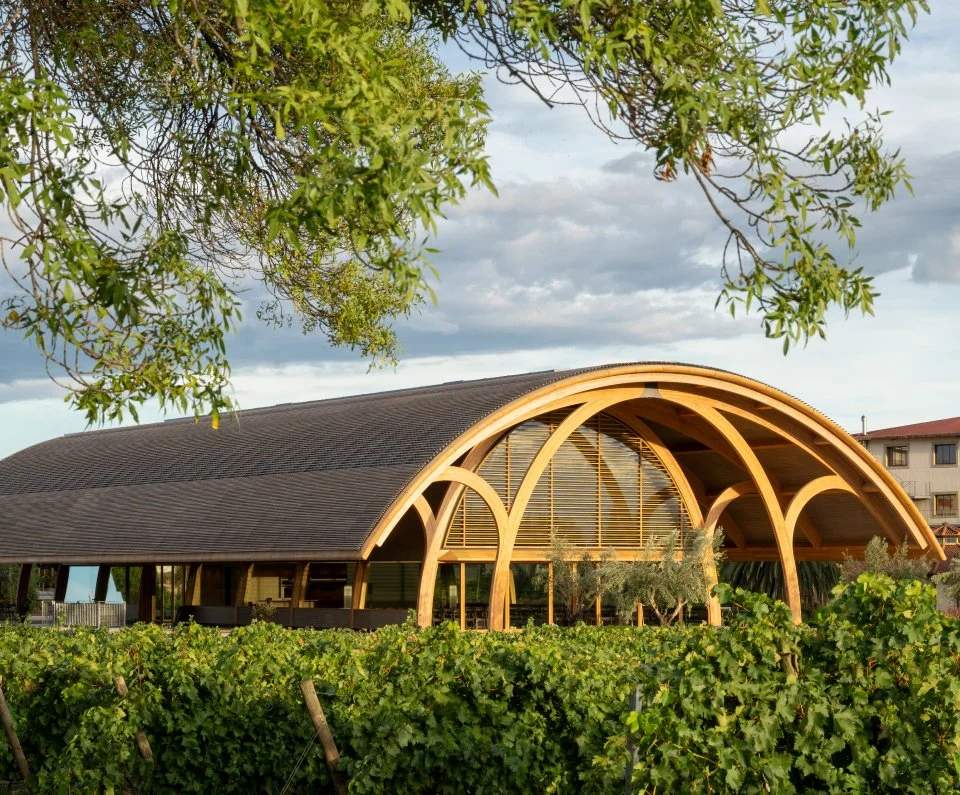
Bodegas Faustino
Rioja Aging Classification
Rioja wines are categorized by the amount of ageing the wine sees in both barrel and bottle before release. Each grade has a set of specific regulations:
Cosecha: Simply meaning “Vintage” these are the simplest wines, often vinified in stainless steel and seeing from zero to under 2 years ageing in oak. Regulations are relatively light, and the wines are fresh and fruit-driven.
Crianza: Wines subjected to a minimum two-year old aging process and kept at least one year in standard 225 liter oak barrels. For white wines and rosés, the minimum ageing period in barrel is 6 months. A Crianza wine shows balance and harmony between primary fruit (primary) aromas and the secondary ones originating from the barrel-aging process.
Reserva: Reds must undergo a minimum aging of 3 years between oak barrel and bottle, with at least 1 year in barrel and at least 6 months in bottle. For white and rosés, the ageing process is 2 years with at least 6 months in barrel. Reserva wines are usually more complex because they have three aroma types: fruity (primary), wood (secondary) and ageing (tertiary), such as tobacco, leather, truffle, etc.
Gran Reserva: Wines from great harvests with a longer minimum aging requirement - for reds, 5-year minimum ageing process, with at least 2 in barrel plus at least 2 years in bottles. For white and rosé wines it’s 4 years and, of those, 6 months minimum in oak barrels. These types of wines have very complex and intense aromas, with layer upon layer of secondary aromatics.