Sweetness in Sparkling Wines
Sparkling wine is pretty much unique in the world of fine wine because the amount of sweetness is controlled, not by the primary fermentation (the one that turns sugar to alcohol, fruit juice to wine), and not by the secondary fermentation, made possible by the addition of unfermented juice (and yeast) to the wine after the primary is complete, creating CO2 which is trapped in the wine to give the wine its sparkle; but by yet another dosage of unfermented juice (this time without yeast), to tweak the final balance of sugar to acidity and give the finished product its final dryness/sweetness.
Historically, Champagne (the first sparkling wine made in the traditional method), was made on the sweeter side, with a dry (sec) version available for those who preferred drier wines. Eventually tastes shifted towards even drier wines, and Extra Dry was created for that market niche. Later still, consumer demand shifted to still drier wines, and Brut (natural, unrefined… ie unsweetened) was created, then Extra Brut and Brut Zero (aka Brut Nature). Today, in the American market, Brut and Extra Dry ate the two main levels commonly available.
Much of this change was driven by the changing position of Champagne in the dining order. In the 1800’s Champagne was generally served either after dessert, with dessert or as an extramel - a wine served between the main courses and dessert. The wine served at that point in the evening was generally much sweeter. As Champagne moved from dessert to the main courses, and over time to the apertif position, demand grew for drier and drier wines. Compare the quote below to the table of today’s dosage levels!
“A classification of sparkling wines distinguished by their destination country. The ‘British taste’ is very “dry”: 22-66g of sugar per liter; the ‘American taste’, “off-dry”: 110-165g; the Germans, French, and Austrians, “sweet”: 165-200g; the ‘Russian taste’, “candied and confectionary”: 275-330g. ”
Sweetness of Sparkling wines as compared to other common beverages
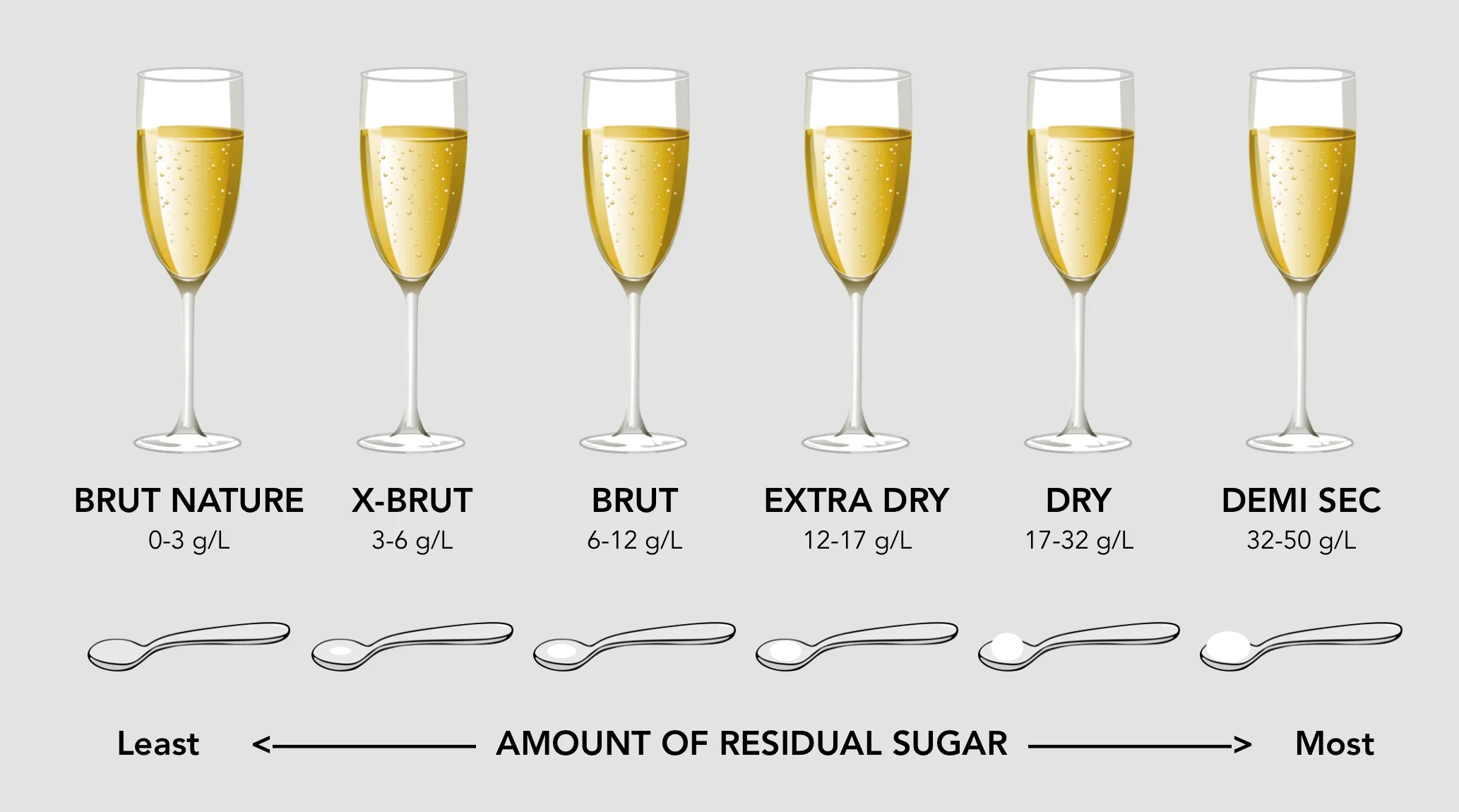
Sweetness is genereally measured in grams (of sugar) per liter (of beverage). Since water weighs 1kilogram per liter, 10 g/L roughly converts to 1% of sugar by weight. Today, Champagne, Cava, Prosecco, other European sparklers, and the American wines made in the Champagne style all use the same sweetness/dryness terms at roughly the same levels of dosage. Below are the sweetness levels found on sparkling wine labels, compared to a few other common beverages:
Vodka Soda 0 g/L
Dry Red or White Wine (Bordeaux, Chianti, Sauv Blanc) 0-2 g/L
Brut Nature 0-3 g/L
X-Brut 3-6 g/L
Kendall Jackson Vintners Res Chard 8 g/L
Bogle Zinfandel 9 g/L
Brut 6-12 g/L
Yellowtail Shiraz 12 g/L
Extra Dry 12-17 g/L
Gin & Tonic 14 g/L
Margarita 20 g/L
Meiomi Pinot Noir 20 g/L
Dry 17-32 g/L
A cup of black tea with 1 tsp sugar 27 g/L
Demi Sec 32-50 g/L
Doux 50+ g/L
Tonic Water 87 g/L
Apple Juice 97 g/L
Coca Cola 110 g/L